 how-to
Can You Keep Your Doctor With a PPO Plan?
Table of Contents
- Can You Keep Your Doctor With a PPO Plan?
- How PPO Networks Work and Doctor Participation
- How to Check if a Doctor Is In-Network
- PPO vs HMO Provider Networks: Key Differences
- Out-of-Network Coverage Explained
- What to Do If Your Doctor Leaves the Network
- Surprise Billing Protections and Your Rights
- Conclusion
- Frequently Asked Questions
Last Updated: October 4, 2026
Can You Keep Your Doctor With a PPO Plan?
Yes, you can keep your doctor PPO plan, but there's an important catch. A PPO plan doesn't guarantee your doctor is in-network. You need to verify your doctor's participation status before enrolling.
A PPO gives you flexibility to see any doctor, but you only get the lowest costs with in-network providers.
Most major doctors participate in PPO networks, but you must confirm your doctor's status before enrolling.
How PPO Networks Work and Doctor Participation
A PPO contracts with a network of doctors and specialists. In-network providers cost you less; out-of-network providers cost significantly more.
Here's how it works in practice:
- In-network care: The plan negotiates lower rates with doctors. You pay a copayment or coinsurance (a percentage of the cost). The plan covers the rest.
- Out-of-network care: You can still see any doctor without a referral. But you'll pay more. The plan covers less, and you're responsible for the difference.
- No referral requirement: Unlike HMO plans, PPO plans don't require you to pick a primary care physician or get referrals to see specialists.
Networks change annually as doctors move, retire, or drop plans. Always verify before enrolling.
A doctor accepting Medicare doesn't guarantee they're in your specific PPO plan's network. Each plan maintains its own network.
How to Check if a Doctor Is In-Network
Verify in-network status by checking the plan's provider directory and calling to confirm. Using both methods takes 10-15 minutes and ensures accuracy.
Using the Provider Directory: Step-by-Step
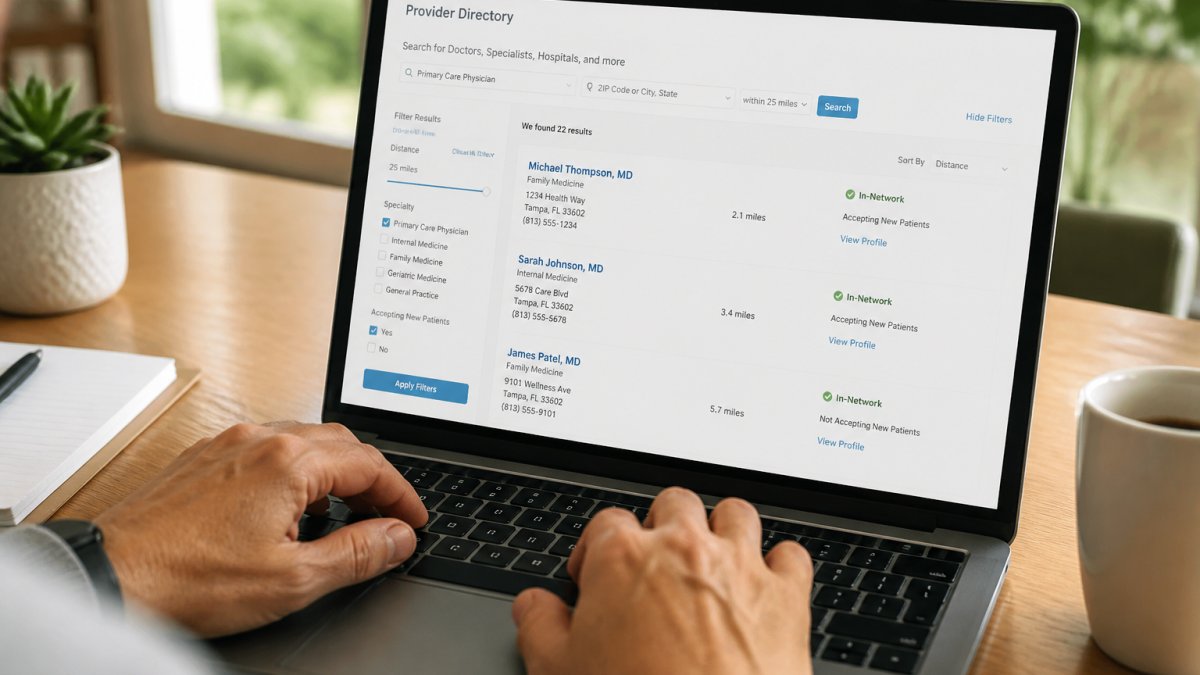
Most PPO plans publish online provider directories. Here's how to search:
-
Find the plan's website. Search "[Plan Name] provider directory" or use Medicare.gov/plan-compare.
-
Locate the "Find a Doctor" or "Provider Directory" tool. This is usually in the main navigation menu or under "Coverage & Costs." Some plans require you to enter your ZIP code first to see which doctors are available in your service area.
-
Enter your doctor's name or practice name. Try both if they differ.
-
Interpret the results carefully. This is where confusion happens. Look for these exact status labels:
- "In-Network" or "Participating Provider" = Your doctor is covered at in-network rates. This is what you want.
- "Out-of-Network" = You can see this doctor, but you'll pay higher out-of-pocket costs.
- "Accepting New Patients" = This label tells you about availability, NOT network status. A doctor can be in-network but not accepting new patients. Don't confuse the two.
- "Contracted" or "Preferred Provider" = Same as in-network. Different plans use different terminology.
- No result found = The doctor may not be in the network, or the directory search tool isn't finding them. This is when you call.
-
Check the plan's service area. PPO networks are county-specific. Verify which county your doctor practices in.
-
Note the directory's last update date. Directories lag 30-60 days, so always call to confirm.
Why Provider Directories Are Unreliable (And What to Do About It)
Provider directories lag 30-90 days. A listed doctor may have recently left the network, or an unlisted doctor may have just joined.
Common problems: a listed doctor may no longer accept the plan, an unlisted doctor may be in-network, or network status varies by county.
Solution: Always follow up the directory check with a phone call. Don't rely on the directory alone.
Contacting Your Plan Directly: The Reliable Method
Calling the plan is the most reliable verification method. Here's the exact process:
-
Find the customer service number. It's on your insurance card, the plan's website, or Medicare.gov. Call during business hours (typically 8 a.m.-8 p.m. Eastern Time, 7 days a week for Medicare Advantage plans).
-
Call and ask directly. Say: "I want to confirm that [Doctor Name] at [Practice Name] is in-network for [Plan Name] in [Your County]."
-
Ask about specialty status. If your doctor is a specialist (cardiologist, orthopedist, etc.), confirm they're in-network for that specialty. Some plans contract with doctors for specific specialties only.
-
Ask about contract status and expiration dates. This tells you if the doctor will stay in-network through year-end.
-
Get confirmation in writing. Ask the representative to send you an email or letter confirming the doctor's in-network status. Save this. If you later receive a surprise bill or the plan denies a claim, this written confirmation protects you.
-
Ask about continuity of care if the doctor recently joined. If the doctor just joined the network, ask: "Is there a waiting period before I can schedule an appointment?" Some plans have short waiting periods for newly contracted providers.
This takes 10-15 minutes and gives you certainty about copayments and coinsurance.
What to Do If You Can't Verify In-Network Status
If the plan can't confirm status, ask for a list of in-network doctors in that specialty, or proceed knowing the doctor is likely out-of-network and you'll pay higher costs.
PPO vs HMO Provider Networks: Key Differences
PPOs require no primary care physician or referrals; HMOs do. PPOs let you see out-of-network doctors at higher cost; HMOs usually don't cover out-of-network care. If keeping your doctor is non-negotiable, a PPO is better, assuming that doctor is in-network.
Out-of-Network Coverage Explained
If your doctor is out-of-network, you can still see them under a PPO plan. But here's what happens:
How out-of-network costs work:
- The plan pays a percentage of what it considers the "allowable charge" (often lower than what the doctor actually bills)
- You pay coinsurance on that allowable charge, plus any difference between the doctor's actual bill and the allowable charge
- You typically hit your out-of-pocket maximum faster with out-of-network care (Source: Centers for Medicare & Medicaid Services (CMS) information on PPO plans)
Example: Out-of-network doctor bills $500; plan's allowable is $300. You pay 40% of $300 ($120) plus the $200 difference = $320 out-of-pocket. In-network: negotiated rate $250, you pay 40% = $100. Out-of-network costs triple the expense.
Out-of-network makes sense only for emergencies, unavailable specialists, or temporary travel care. For ongoing care, verify in-network status upfront.
What to Do If Your Doctor Leaves the Network
If your doctor leaves the network, you can switch plans during Annual Enrollment (Oct 15-Dec 7), switch doctors, continue out-of-network at higher cost, or request a continuity-of-care exception. Check network status every October.
Surprise Billing Protections and Your Rights
Federal law protects you from surprise medical bills in specific situations. Understanding these protections is critical if you're considering out-of-network care or if you've already received an unexpected bill.
What Federal Surprise Billing Law Covers
The Surprise Billing Protection Act (part of the No Surprises Act, effective January 1, 2022) limits your out-of-pocket costs in these scenarios:
Emergency services: If you receive emergency care at an out-of-network hospital or facility, the plan must cover it at in-network rates. You pay only your in-network copayment or coinsurance, not the full out-of-network cost difference. This applies even if the emergency room is out-of-network and you had no choice.
In-network facility, out-of-network provider: If you're admitted to an in-network hospital for a planned procedure and an out-of-network doctor (anesthesiologist, radiologist, surgeon's assistant) treats you without your knowledge, you're protected. The plan must cover that doctor at in-network rates.
Air ambulance services: If you're transported by air ambulance to the nearest appropriate facility, the plan covers it at in-network rates.
What Surprise Billing Law Does NOT Cover
It's equally important to know what's NOT protected:
Non-emergency out-of-network care you knowingly choose: If you deliberately schedule an appointment with an out-of-network doctor for a non-emergency reason, surprise billing protections don't apply. You're responsible for the full out-of-network cost difference.
Out-of-network care at out-of-network facilities: If you go to an out-of-network urgent care center or surgery center for non-emergency care, you're not protected. The plan pays its allowable amount; you pay the difference.
Services not covered by your plan: Surprise billing protections only apply to services your plan covers. If your plan doesn't cover a service, surprise billing law doesn't help.
How to Respond If You Receive a Surprise Bill
If you receive an unexpected out-of-network bill, follow these steps:
-
Don't pay immediately. Review the bill carefully. Note the date of service, the provider's name, the facility, and the amount billed.
-
Contact your plan's customer service within 30 days. Call the number on your insurance card and say: "I received an out-of-network bill for [Service] on [Date] at [Facility]. I believe this should be covered under surprise billing protections. Can you investigate?" Provide the provider's name and the bill amount.
-
Explain why you believe you're protected. Use one of these reasons:
- "This was emergency care."
- "I was admitted to an in-network hospital and didn't know the provider was out-of-network."
- "I received this service at an in-network facility but the provider was out-of-network."
-
Request written confirmation of the plan's decision. Ask the plan to send you a letter explaining whether they're covering the bill under surprise billing protections and what you owe. Keep this letter.
-
If the plan denies coverage, file a complaint. You can file a complaint with your state's Department of Insurance or with the federal Centers for Medicare & Medicaid Services (CMS).
The Financial Impact of Surprise Billing Protection
Without surprise billing protection, an unexpected out-of-network bill can be substantial. Here's a realistic example:
Scenario: You go to an in-network hospital for a planned knee surgery. The surgeon is in-network, but the anesthesiologist is out-of-network. You don't know this until you receive the bill.
- Anesthesiologist's bill: $2,000
- Plan's in-network allowable amount: $800
- Without surprise billing protection: You'd owe the full $2,000 (or at least $1,200 after your coinsurance).
The difference is $1,040. This is why surprise billing protections matter.
Preventive Steps to Avoid Surprise Bills
While surprise billing law protects you in certain situations, prevention is better:
-
Ask about all providers before a planned procedure. If you're scheduling surgery or a procedure at an in-network facility, ask: "Who will be the anesthesiologist, radiologist, and any other doctors involved? Are they all in-network for my plan?" Get names and confirm in-network status before the procedure.
-
Request in-network providers in writing. When you schedule a procedure, ask the facility to document your request for in-network providers. This creates a paper trail if a surprise bill arrives.
-
Verify your doctor's network status before each visit. Even if your doctor was in-network last year, they may have left the network. Check before scheduling.
-
Ask about out-of-network costs upfront. If you must see an out-of-network provider, ask the plan: "What will my out-of-pocket cost be for this service?" Get a cost estimate in writing.
Your Right to an Explanation of Benefits
After any medical service, your plan must send you an Explanation of Benefits (EOB) within 30 days. The EOB shows:
- What the provider billed
- What the plan's allowable amount is
- How much the plan paid
Review every EOB, even for in-network care. If you see an unexpected charge or if the plan's allowable amount seems very low, contact the plan immediately. Errors happen, and catching them early prevents surprise bills.
Conclusion
To keep your doctor PPO, you must verify in-network status before enrolling. Use the provider directory and call to confirm. If in-network, you'll pay lower costs with no referral requirements. At Your Medicare Agent Medicarehelpinfl, we offer clear, expert information on Original Medicare, Medicare Advantage, and supplemental plans to ensure you make informed decisions about your healthcare coverage. Let us help you secure the right protection for your health and peace of mind.
Frequently Asked Questions
How do I check if my doctor is in-network for a PPO plan?
Log into your PPO plan's online provider directory using your member ID, or call the customer service number on your insurance card. Search by your doctor's name or location. You can also contact your doctor's office directly and ask them to verify your plan's in-network status. Many offices keep lists of accepted insurance plans. Verify coverage before your appointment to avoid unexpected out-of-pocket costs.
Can you use a PPO plan out of state?
Yes, PPO plans typically cover medical services out of state. You can see any doctor or specialist without a referral, whether in-network or out-of-network. However, out-of-state out-of-network providers may result in higher out-of-pocket costs. Check your plan's benefit booklet for out-of-state network adequacy and coverage details, as some plans have limited networks in certain regions. Always verify coverage before scheduling care outside your home state.
What happens if my doctor leaves the PPO network?
If your in-network doctor leaves the network, you have several options. You can continue seeing them as an out-of-network provider and pay higher coinsurance rates, or switch to another in-network provider. Many plans allow you to request continuity of care for ongoing treatment with your departing doctor for a limited time. Contact your plan immediately when you learn your doctor is leaving to understand your options and any special enrollment periods that may apply.
What is the difference between PPO and HMO provider networks?
PPO networks offer flexibility to see any doctor without referrals, though in-network care costs less. HMO networks require you to choose a primary care physician and get referrals to see specialists; you cannot use out-of-network providers except in emergencies. PPO plans provide more healthcare flexibility and specialist access without referrals, while HMO plans typically have lower premiums but less provider choice. Your network limitations depend on which plan type you select.